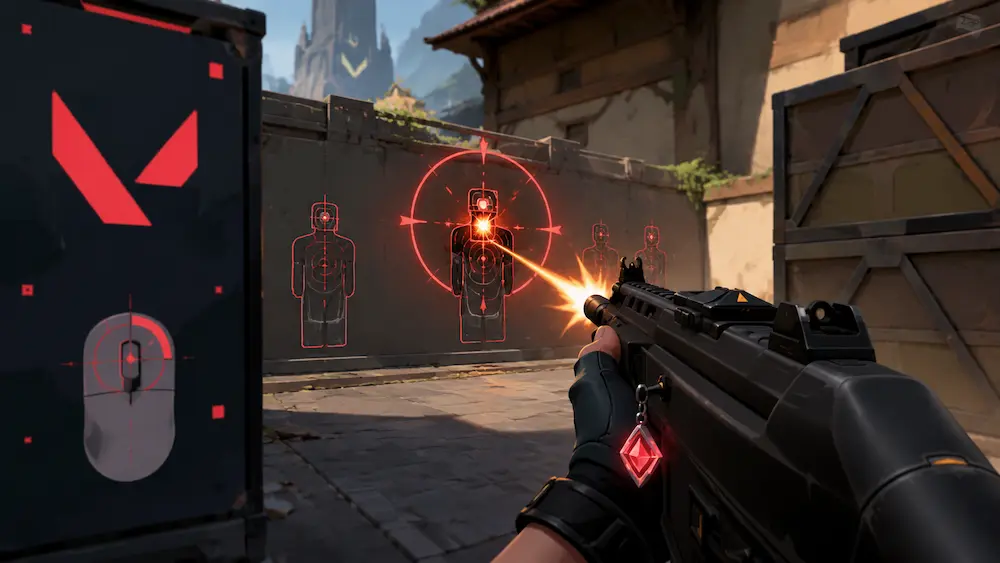
A fast flick that lands perfectly on an enemy’s head looks effortless, but most players underestimate what happens between seeing a target and clicking. The mouse movement is only one part of the skill. The real challenge is controlling the start point, stopping accurately, making tiny corrections, and firing at the right moment.
Many players try to improve flick shots by simply moving faster. That approach often creates inconsistent aim because speed gets trained before control. A better method is to build accuracy first, then gradually increase your pace through focused practice.
What makes a VALORANT flick shot accurate?
A flick is a quick mouse movement that brings the crosshair onto a target that appears outside your current aim position. In a tactical shooter like VALORANT, the goal is not just reaching the target quickly. The goal is arriving accurately enough to deliver a clean shot.
Two skills separate reliable flicks from random reactions:
- Initial movement: The fast snap toward the target.
- Micro-correction: The small adjustment that places the crosshair exactly where it needs to be.
Many missed flicks happen because players focus only on the first movement. They reach the target area but stop slightly too far away, too short, or at the wrong height. A controlled flick includes a short correction phase before the shot.
Good flicking also depends on click timing. Shooting too early creates missed shots even if the mouse movement was close. The best practice habit is to recognize the target, move with intention, confirm your crosshair placement, then click.
Train accuracy before speed
A common mistake in aim practice is trying to match professional-level speed immediately. Fast movement with poor control only reinforces overshooting and panic corrections.
Start with slower flicks where every shot has a clear purpose:
- Pick a target.
- Move your crosshair in one smooth motion.
- Stop on the target.
- Fire only after confirming your position.
The goal is to make the movement feel repeatable. If your flick only works when you get lucky, it is not yet a reliable mechanic.
A useful benchmark is consistency. If you can repeatedly land accurate shots at a comfortable speed, then increase the pace slightly. The improvement comes from making your existing movement cleaner, not from forcing faster reactions.
Use the dead-stop method to understand your mistakes
One of the simplest ways to improve flick control is the dead-stop drill.
The process is straightforward:
- Flick to the target.
- Click.
- Keep your mouse still for a brief moment before moving again.
This pause helps you see exactly where your crosshair landed. If you missed above the head, you know you overshot. If you stopped short, you know the flick lacked enough movement.
The drill removes unnecessary motion and isolates the flick itself. Instead of combining tracking, movement, correction, and shooting at once, you focus on one mechanical action.
You can also add a reset point. For example, place your crosshair on a specific object before every attempt, then flick to the target. Starting from the same position makes it easier to judge distance and consistency.
Build the micro-correction habit
Perfect first-try flicks are rare, even among highly skilled players. Small adjustments are part of normal aiming.
A practical flick sequence looks like this:
- Start from proper crosshair placement.
- Snap toward the target.
- Make a small correction if needed.
- Fire once your aim is settled.
This approach works better than trying to force every flick into a single perfect movement. In real VALORANT fights, enemies move, angles vary, and your starting position changes constantly.
Micro-corrections become especially valuable during defensive holds. An opponent may appear slightly higher, lower, or farther away than expected. Being able to adjust quickly after the first movement makes your aim more dependable.
Practice flicks with VALORANT-specific drills
General aim trainers can help develop mouse control, but VALORANT practice should also include situations that resemble actual matches.
100-bot headshot practice
The Shooting Range remains one of the most useful places to build fundamentals.
Try this routine:
- Spawn 100 bots.
- Focus only on headshots.
- Choose a consistent starting position.
- Flick only when your crosshair placement is ready.
- Avoid shooting early just because the target appeared.
The priority is clean accuracy. Once your shots become consistent, gradually increase your speed.
You can also use external aim routines designed around flicking, tracking, and precision practice. A browser-based option like VALORANT aim training practice can help you create short warm-up sessions before matches without needing to launch a full training setup.
Pillar-to-pillar flick drills
This drill adds a clear distance reference.
Stand in the Shooting Range and choose a fixed reset point, such as a pillar. Return your crosshair there after every shot, then flick toward a target that appears elsewhere.
The benefit is consistency. You learn how much movement different distances require instead of relying on random mouse adjustments.
Strafe-stop-flick practice
Real fights rarely happen while you are standing perfectly still. Movement control matters.
Practice this sequence:
- Strafe left or right.
- Stop your movement.
- Flick to the target.
- Fire when your crosshair settles.
Many players try to flick while still changing direction, which creates unnecessary instability. Learning the timing between movement and shooting makes your aim transfer better into actual rounds.
Check your sensitivity before changing your routine
A poor sensitivity setting can make flick training frustrating. There is no universal “correct” sensitivity, but your settings should allow both fast movement and small corrections.
Your sensitivity should let you:
- Reach common angles without running out of mouse space.
- Make small head-level adjustments without feeling shaky.
- Repeat the same movements comfortably.
Before changing settings, give your current sensitivity enough time. Constantly switching values can prevent muscle memory from developing.
A better test is whether you can perform the same flick repeatedly. If your results vary wildly from one attempt to another, the problem may be technique rather than the number itself.
Create a short warm-up routine before matches
You do not need hours of practice before every game. A focused 15–20 minute routine is usually enough to prepare your mechanics.
A simple schedule:
First 5 minutes: controlled flicks
Use slow, accurate shots. Focus on stopping your crosshair correctly rather than chasing speed.
Next 5–10 minutes: correction practice
Use dead-stop flicks and reset points. Pay attention to whether your misses come from overshooting, undershooting, or poor timing.
Final minutes: match-style movement
Add strafing, stopping, and flicking together. The goal is to connect isolated practice with actual gameplay situations.
Tracking your progress can help. Instead of only recording your score, pay attention to how many shots feel controlled versus accidental. Over time, cleaner repetitions are a better sign of improvement than a single high score.
Better flicks come from repeatable control
Flicking is not about making every mouse movement faster. It is about making the movement predictable enough that speed can be added later.
Players who improve their flick shots usually spend less time chasing highlight moments and more time building reliable mechanics: stable crosshair placement, controlled stops, accurate corrections, and consistent timing.
A strong warm-up routine turns those skills into habits. Once the basics become automatic, faster flicks become a natural result rather than something you have to force.